Animation, gaming, and design are no longer just hobbies—they are serious global career industries. With movies, OTT platforms, games, apps, and digital content growing rapidly, many students and parents ask:
“What art skills are actually required to build a career in animation, gaming, or design?”
This blog explains the real, foundational art skills needed—beyond software—and helps students understand where to start and what to focus on.
________________________________________
Why Art Skills Matter More Than Software
One common mistake beginners make is believing that learning software alone is enough.
In reality:
• Software changes every few years
• Strong art skills last a lifetime
Studios hire artists who can draw, observe, design, and think visually—not just click tools.
________________________________________
Core Art Skills Required for Animation, Gaming & Design
Let’s break down the essential skills industry professionals actually use.
________________________________________
1. Strong Drawing Fundamentals (Non-Negotiable)
Drawing is the foundation of all visual industries.
Every animation or game artist must understand:
• Line control
• Shapes and forms
• Proportion
• Light and shadow
???? Drawing for game design and animation always starts with fundamentals, not style.
________________________________________
2. Understanding Form & 3D Thinking
Animation and games are built in three-dimensional space.
Artists must learn:
• Basic 3D forms (cube, sphere, cylinder)
• How light wraps around objects
• Volume and depth
This skill comes from drawing, sculpting, and observation, not software shortcuts.
________________________________________
3. Perspective & Spatial Awareness
Perspective helps artists:
• Place characters in environments
• Design believable worlds
• Create depth and realism
Whether it’s a game level or an animated scene, perspective is essential.
________________________________________
4. Anatomy & Gesture (For Characters)
For animation and character design, artists must understand:
• Human and animal anatomy (basic level)
• Gesture drawing for movement
• Balance and weight
You don’t need medical-level anatomy—but structure and movement are essential.
________________________________________
5. Visual Storytelling Skills
Animation and games are about telling stories visually.
Artists need to understand:
• Composition
• Camera angles
• Emotion and mood
• Visual clarity
A strong artwork communicates even without words.
________________________________________
6. Color Theory & Lighting
Color affects emotion and realism.
Artists must learn:
• Color harmony
• Warm vs cool colors
• Lighting moods
• Atmosphere and depth
Good color skills separate amateurs from professionals.
________________________________________
7. Design Thinking & Creativity
Design careers require more than drawing.
Artists must learn:
• Problem-solving through visuals
• Creative thinking
• Style development
• Purpose-driven design
This is why design education focuses on thinking, not copying.
________________________________________
8. Digital Art Skills (After Basics)
Only after strong fundamentals should students move to:
• Digital drawing and painting
• Software like Photoshop, Procreate, Blender
• Digital workflows
Digital tools enhance skills—they don’t replace them.
________________________________________
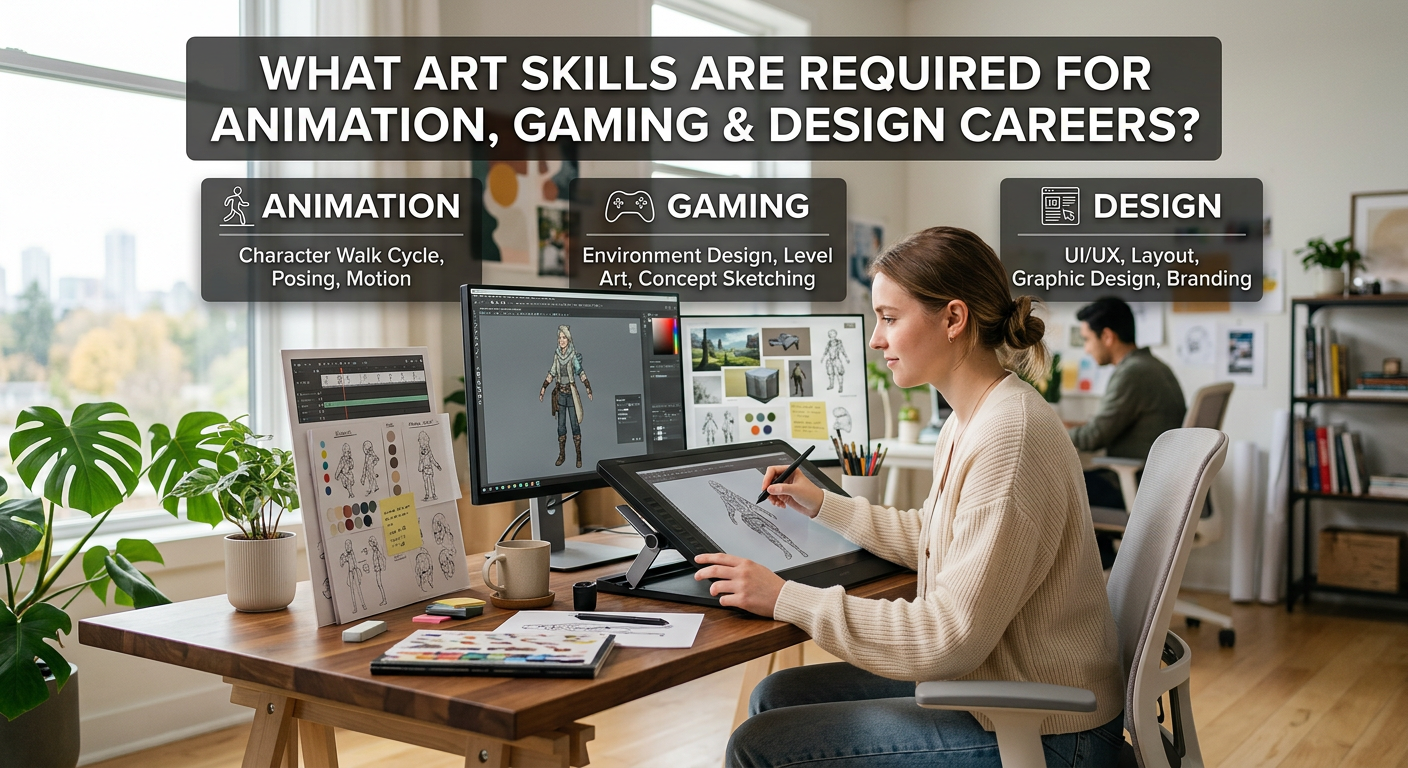
Skills Required Specifically for Each Career
Animation Careers
• Drawing & anatomy
• Gesture & movement
• Storyboarding
• Timing & expression
________________________________________
Game Design & Game Art
• Drawing for game design
• Environment design
• Character design
• Perspective & level design
________________________________________
Design Careers (UI, Illustration, Concept Art)
• Drawing fundamentals
• Color & composition
• Visual communication
• Creative problem-solving
________________________________________
Common Mistakes Students Should Avoid
- Jumping directly into software
- Skipping drawing practice
- Copying styles without understanding basics
- Expecting quick results
- Not building a strong foundation
These mistakes cost years of struggle later.
________________________________________
How Early Should Students Start Learning These Skills?
• Ages 8–12: Drawing fundamentals + creativity
• Ages 13–16: Strong foundations + observation + shading
• Ages 16+: Portfolio-focused training + digital tools
Starting early gives students a huge advantage.
________________________________________
How Ankona School of Art Prepares Students for Creative Careers
At Ankona School of Art, career preparation begins with strong artistic foundations.
What Makes Ankona Different:
• 25+ years of teaching & industry experience
• Focus on fundamentals before software
• Structured learning path for kids & teens
• Guidance for animation, gaming & design careers
• Portfolio-oriented mentoring
Students learn how to think like artists, not just use tools.
________________________________________
Final Advice for Students & Parents
If you are serious about animation, gaming, or design:
• Start with drawing fundamentals
• Learn to observe and think visually
• Choose structured guidance
• Be patient and consistent
Strong art skills open doors across multiple creative industries.
________________________________________
Start Your Creative Career the Right Way
If you want to prepare for animation, gaming, or design careers, start with the right foundation.
Join a Free Introductory Art Class
Get Career Guidance from Expert Mentors
Explore Art Courses at Ankona School of Art
________________________________________
Ankona School of Art
Building strong artists for the creative industries